00:00
/* Main1.java : create seperate class and impletement the funcional interface, old */
/* how to use functional interface mt*/
/* Way-1 : old way-before using functional interface */
package lambda;
public class Main1 {
public static void main(String[] args) {
System.out.println("\n_ _My System starts........\n");
MyInter1 myInter = new MyInterImpl1(); //inherit the property on myInter
MyInterImpl1 myInter1 = new MyInterImpl1();
myInter.sayHello();
myInter1.sayHello();
}
}
/* MyInter1.java : functional interface */
package lambda;
@FunctionalInterface
public interface MyInter1 {
public abstract void sayHello();
}
/* MyInterImpl1.java : separate class ( MyInterImp.java ) and implements this interface*/
package lambda;
public class MyInterImpl1 implements MyInter1{
@Override
public void sayHello() {
System.out.println("_ _ I am saying hello from MyInterImp\n");
}
}
/* Main2.java */
/* Way-2 : anonumus class */
package lambda;
public class Main2 {
public static void main(String[] args) {
System.out.println("\n_ _My System starts........\n");
// not the parent but the object is for the anonymus child class */
MyInter1 mi1 = new MyInter1(){
@Override
public void sayHello() {
System.out.println("\n_ _by using anonymus class ........\n");
}};
mi1.sayHello();
MyInter1 mi2 = new MyInter1() {
@Override
public void sayHello() {
System.out.println("\n_ _by using anonymus class second ........\n");
}};
mi2.sayHello();
}
}
/* MyInter1.java : functional interface */
package lambda;
@FunctionalInterface
public interface MyInter1 {
public abstract void sayHello();
}
/* Main3.java */
/* Way-3 : lambda expression */
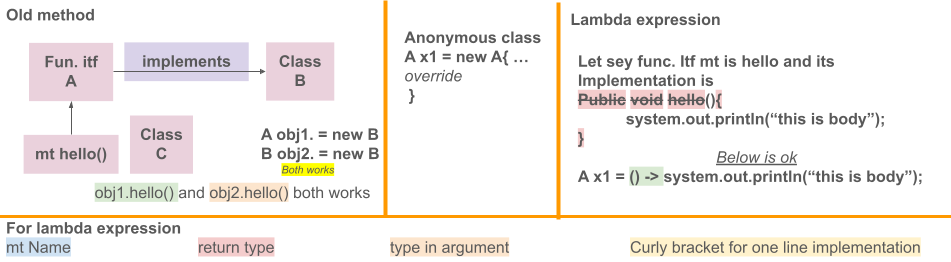
/*
Step
1. fnctional itf =
2. itf obj. with lambda + mt implementation
3. use object to override interface m/t
copy whole the code, then delete everything ,
1. even the name ,
2. return type and
3. type in agrument
*/
public class Main3 {
public static void main(String[] args) {
System.out.println("\n_ _My System starts........\n");
/* public abstract void sayHello(); delete all except the () and implemet its method using {};*/
MyInter1 i = ()->System.out.println("by using LAMBDA EXPRESSIONS...\n");
i.sayHello();
Sumtwo st = (int a , int b) -> (a + b); // or
/* Sumtwo st = (a , b) -> a+b;*/
System.out.println(st.sum(10, 20));
/* LenStr ls = (String str) -> str.length(); */
LenStr ls = (str) -> str.length();
System.out.println(ls.strLen("rajat"));
}
}
/* MyInter1.java : fun. itf. */
package lambda;
@FunctionalInterface
public interface MyInter1 {
public abstract void sayHello(); // delete all, excepts ()
}
/* Sumtwo.java : fun. itf. */
package lambda;
@FunctionalInterface
public interface Sumtwo {
int sum(int a, int b);
}
/* LenStr.java : fun. itf. */
package lambda;
@FunctionalInterface
public interface LenStr {
public abstract int strLen(String str);
}
/* runnable is fun. itf , use it by lambda expression */
/* 1 to 10 , one sec delay */
package lambda;
public class ThreadLambda {
public static void main(String[] args) {
Runnable rt = () -> {
for(int i =1; i<=10;i++){
System.out.println("value of i is = "+i);
try {
Thread.sleep(1000);
} catch (InterruptedException e) {
e.printStackTrace();
}
}
};
Thread t = new Thread(rt);
t.setName("maoj");
t.start();
/* print tabel of 2 using the lambda expression */
Runnable rt1 = () -> {
for(int i =1; i<=10;i++){
System.out.println("2 * "+i+"="+ i*2);
try {
Thread.sleep(1000);
} catch (InterruptedException e) {
e.printStackTrace();
}
}
};
Thread t1 = new Thread(rt1);
t1.setName("rajat");
t1.start();
}
}
/* DesktopApp.java : fun. itf. */
package lambda;
import java.awt.FlowLayout;
import java.awt.event.ActionEvent;
import javax.swing.*;
public class DesktopApp{
public static void main(String[] args) {
JFrame frame = new JFrame("My Window");
frame.setSize(400,400);
frame.setLayout(new FlowLayout());
JButton button = new JButton("Click Me !!");
frame.add(button);
/* button.addActionListener(new ActionListener() {
@Override
public void actionPerformed(ActionEvent e) {
JOptionPane.showMessageDialog(button, e, "this is click", 0);
}
}); */
//using fun. itf.
button.addActionListener((ActionEvent e) -> {
System.out.println("button click");
JOptionPane.showMessageDialog(null, "hey", "my message", 0);
});
frame.add(button);
frame.setDefaultCloseOperation (JFrame.EXIT_ON_CLOSE);
frame.setVisible(true);
}
}
WR01 - wrapper classs
/*
Wrapper Classes:
Primitive API Class package parent
Data Types (java.lang)
boolean Boolean > java.lang > java.land.Object
char Character > java.lang > java.land.Object
byte Byte > java.lang > java.land.Number > java.land.Object
short Short > java.lang > java.land.Number > java.land.Object
int Integer > java.lang > java.land.Number > java.land.Object
long Long > java.lang > java.land.Number > java.land.Object
float Float > java.lang > java.land.Number > java.land.Object
double Double > java.lang > java.land.Number > java.land.Object
> all class are final
> object of Wrapper class immutable
> wrapper class me bahut sare constructor aur method hote hai
> agar wrapper class na ho to programmer ko method bhee code karne hoge
> collection me value object ke form me save hoti thee pahle , is leeaye iska use karte they
*/
public class WR02 {
public static void main(String[] args){
/* use to make object of primitive type , wrapper cls ct old way , DEPRECIATED */
Integer i1 = new Integer(12); // 12
Integer i2 = new Integer("56"); // 56
Integer i3 = new Integer("a0"); // numberformatexception
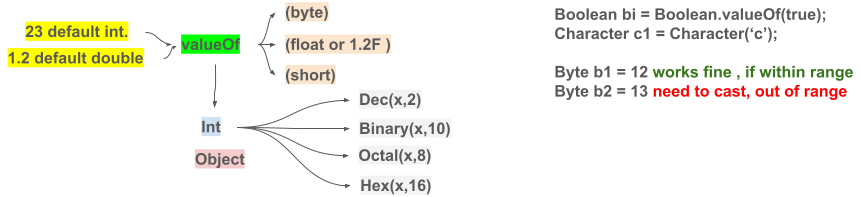
/* valueOf - new way wrapper class mt, PRIMITIVE TO OBJECT */
Integer i4 = Integer.valueOf(23); // 23
Character c1 = Character.valueOf('a'); // a
/* valueOf : Boolean */
Boolean b1 = Boolean.valueOf(true); // true
Boolean b2 = Boolean.valueOf(tRu); // false
Boolean b3 = Boolean.valueOf(tRuE); // true
Boolean b4 = Boolean.valueOf(raja); // false
/* valueOf : Float */
Float f1 = Float.valueOf(1.2f); // 1.2
Float f2 = Float.valueOf(12.34); // lossy conversion from double to float
Float f4 = Float.valueOf(12.34F); // F
/* valueOf : int = hex , oct, binary */
Integer i5 = Integer.valueOf("111", 2); // Decimal = 7
Integer i6 = Integer.valueOf("111", 10); // Binary = 111
Integer i7 = Integer.valueOf("71", 8); // Octail = 57
Integer i8 = Integer.valueOf("a1", 16); // Hex = 57
System.out.println(i7);
}
}
/* int to byte within range, No Need to type cast */
public class WR03 {
public static void main(String[] args) {
byte x = 12; // works fine , range = -128 to 127
pro(x);
}
static void pro(byte x){
System.out.println(x); // 12
}
}
/* int-byte out of range, compile time error */
public class WR04 {
public static void main(String[] args) {
byte x = 128; // cant convert form int to byte
pro(x);
}
static void pro(byte x){
System.out.println(x);
}
}
/* direct mt call with int value, incompatible types: possible lossy conversion from int to byte */
public class WR05 {
public static void main(String[] args) {
byte b1 = 12;
pro(12); // default int
}
static void pro(byte x){
System.out.println(x);
}
}
/* above with casting, direct mt call with int value with type cast */
public class WR06 {
public static void main(String[] args) {
byte b1 = 12;
pro((byte)12);
}
static void pro(byte x){
System.out.println(x); // 12
}
}
/* at time of primitive to object convrsion , need to specified type in brakcket */
public class WR07 {
public static void main(String[] args) {
Byte b1 = Byte.valueOf(12); // error : default int
Byte b2 = Byte.valueOf((byte)12); // workks fine
/* same with short */
Short b3 = Short.valueOf(34); // error : default int : no suitable mt found
Short b4 = Short.valueOf((short)34); // 34
/* double to float object */
Float f1 = Float.valueOf(2.34); // error : double to float can not be converted
Float f2 = Float.valueOf((float)2.34);
Float f3 = Float.valueOf(2.34f);
Float f4 = Float.valueOf(2.34F);
/* Byte */
byte b1 = 128; // error : out of range .incompatible types: possible lossy conversion from int to byte
byte b1 = 127; // in range
Byte b2 = Byte.valueOf(127); // not applicable for the argument int
Byte b3 = Byte.valueOf((byte)127); // type cast , works fine
Byte b4 = Byte.valueOf(128); // not applicabel and out of range
Byte b5 = Byte.valueOf((byte)128); // -128
Byte b6 = Byte.valueOf("56"); // 56
Byte b7 = Byte.valueOf("128"); // java.lang.NumberFormatException
Byte b8 = Byte.valueOf("1a8"); // java.lang.NumberFormatException
Short b9 = Short.valueOf(32767); // java.lang.NumberFormatException
Short b10 = Short.valueOf((short)32767); // 32767
Short b11 = Short.valueOf((short)32768); // -32768
}
}